


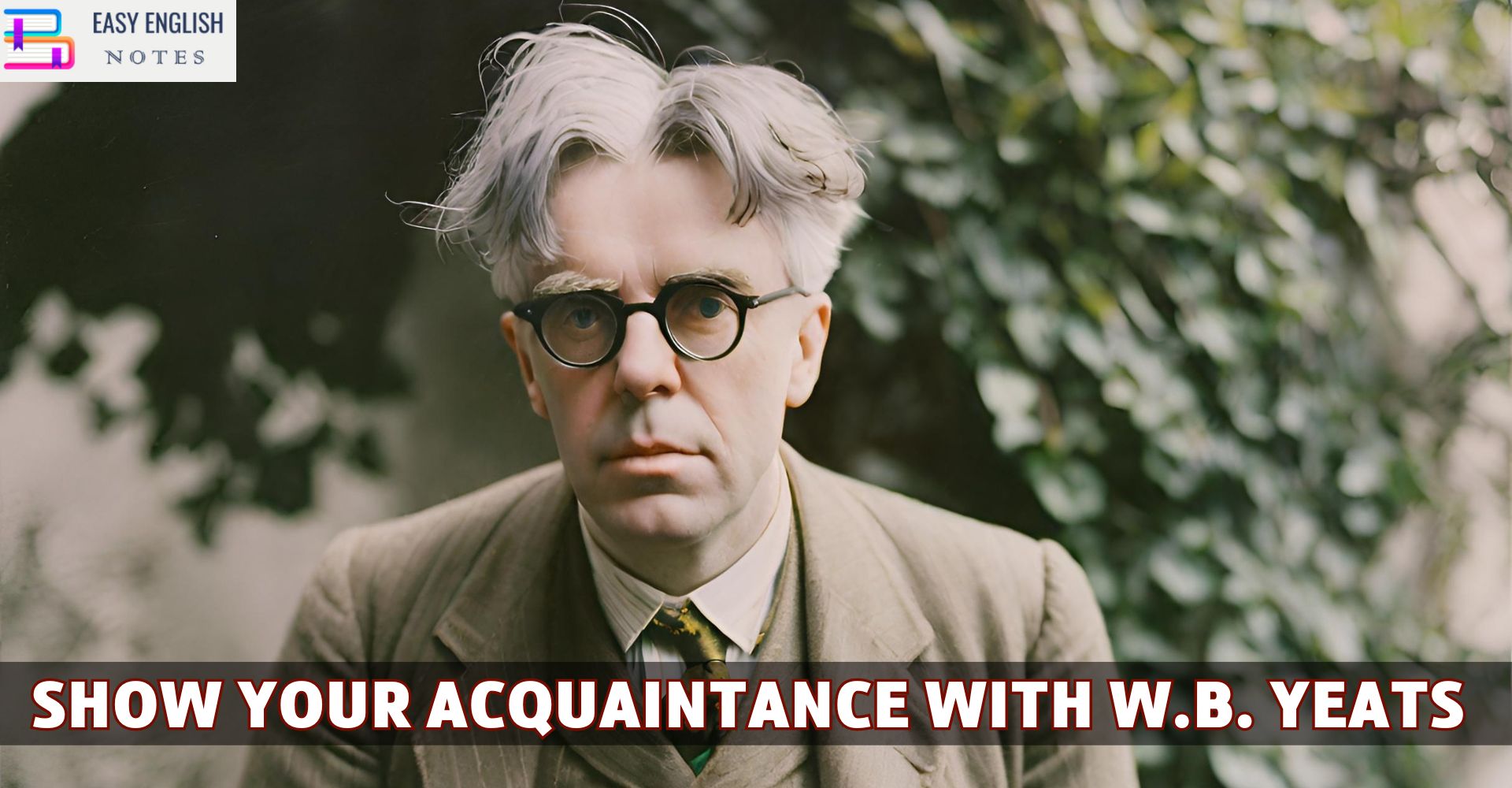
Show Your Acquaintance With W.B. Yeats
William Butler Yeats was the son of John Butler and Susan Yeats. He was born in 1865 and died in 1939. His father was a painter. As a schoolboy. William, who was gentle and physically frail, was protected from excessive bullying by the school’s best athlete, who shared William’s interest in moths and butterflies. One of his reports described him as a “very good boy”, but his French and spelling were weak and his spelling remained acentric throughout his life. He was educated at the Godolphin School, Hammersmith and Erasmus Smith School, Dublin. In 1880, after remaining in England for sometime, the Yeats family returned to Ireland, their native place.
Despite, William’s somewhat aloof bearing at school, his school fellows were beginning to recognise him as a gifted writer. When he was nineteen, Yeats had two lyrics published in the Dublin University Review, and he began to meet other writers and intellectuals who recognised his promise. During the next few years he was much occupied with the work of the Theosophical society, and his new philosophical or pseudo philosophical ideas produced a number of poems.
Yeats as Poet: W.B. Yeats and T.S. Eliot are the two most important poets of the twentieth century. Until the age of about forty. Yeats was little more than a talented minor poet. His poetry linked with the decadent’ poets of time. But perceptible change in his poetic practice began with the publication of his volume “The Green Helmet” (1910) Yeats achieved a wholly individual voice in Michael Robarts and the Dancer” (1921). The last twenty years in his life (1919-1939) produced the finest poetry.
The greatest poet since Wordsworth, Yeats is not, however, an English poet at all. He is an Irish poet and his best work is a commentary on the history of Ireland at the establishment of its freedom. In 1889 he fell in love with Maud Gonne who figures prominently in his poetry. As a poet he grew up that loss of the romantic, but his nature poetry was shaped by three fundamental tendencies of his mind. He expressed on poetry what he often called personality; symbolism in central to his art, and his poems exhibit his tendency to think in terms of antithesis.
Most romantics agree that most important quality of Yeats’s poetry is its wisdom. But it is not the calm wisdom of old age. It grew out of his deeply felt passion-love and politics. The two main sources of his wisdom were his sense of nobility and his sense of reverence. In his famous poem “A Prayer For my Daughter” he wishes her beauty, courtesy, lack of hatred, self-reliance and most important of all, a life based on ‘ceremony and custom’.
Yeats’ disillusionment also came from another source. It was his love affairs with Maud Gonne, a famous beauty of the time.
Also Read :
- Compare Hamlet with Macbeth, Othello and other Tragedies
- “The Pardoner’s Tale” is the finest tale of Chaucer
- Prologue to Canterbury Tales – (Short Ques & Ans)
- Confessional Poetry – Definition & meaning
- Line By Line Explanation Of The Poem The Eve of St. Agnes
W.B. Yeats began his poetic career under the influence of the Decadent poets of the nineties. His early poetry is sweet and musical. It is dreamy and escapist in temper. but as the poet advanced in years, there was a change in his poetry. He moved with the times. His poetry gradually became realistic In his poem, A Coat, we find a record of this profound change. His poetry loses its mythological decorativeness but it is still on a visionary perception of life. Yeats was now nearly fifty. He now moved into a new world. Now he seemed to move more and more towards life. At any rate he had left fairy-land. Bitterly he lamented in September, 1913 that “Romantic Ireland’s dead and gone.”
Byzantium and The Second Coming- the most memorable poems of Yeats belong to later periods of his career and they are significant for their visionary content. In The Second Coming, the power of the seer came upon him, and he prophesied (predicted) the dawn of an evil age. The horrors of the evil age weighed upon him, but they did not depress him. His later poems are increasingly metaphysical. To the end his great personality remained enigmatic and mysterious.
In 1913. Yeats wrote a poem deploring the lack of daring and imagination in contemporary Ireland. then in 1916 occurred the Easter Rising. This rising was so unexpected and so unworldly that it brought Romantic Ireland back but with a difference. The leaders of the Easter rising were men of mixed types. Yeats had little personal sympathy with most of these leaders. The Irish people had at first ignored or disliked the rebels, but they swung over the sixteen leaders of the uprising. Yeats, however, seems to have been caught in two minds. But he could not be sure that their sacrifice was necessary. “Was it needless death after all?”
Year’s own view of Ireland was not consistent throughout his life. It was itself sometimes distorted or blurred by abstractions, by wishful thinking, by sentimentality, by partisanship. In his early days, he tried to equate Ireland with a Celtic utopia, a land of beautiful dreams. During this period, his nationalism was orthodox and romantic. In his middle years. some experience of public life and politics disillusioned him. But his contract with lady Gregory and J.M. Synge restored to him the image of the Ireland of his childhood.
Thus Yeats was an eminent poet and play write and in 1923 he was awarded the noble prize for literature. He died on 18th January 1939.
The period of poetic activity in the case of Yeats extended over fifty years and all through this period, there was gradual and steady evolution. He began by producing poems in the Pre-Raphaelite romantic tradition and he has come to be known as the last of the great romantics. He showed a great interest in Irish mythology and folklore. These early poems were written in a smooth and simple manner and they had an airy grace. But with the turn of the century, Yeats abandoned his interest in the celtive revival and the 19th century romantic openly professed to be a 20th century realist. His later poetry is nakedly real in character. It is even brutal course and throbbing with manly vigour. There is no decoration and superfluity in style.
PLEASE HELP ME TO REACH 1000 SUBSCRIBER ON MY COOKING YT CHANNEL (CLICK HERE)
No Comments