


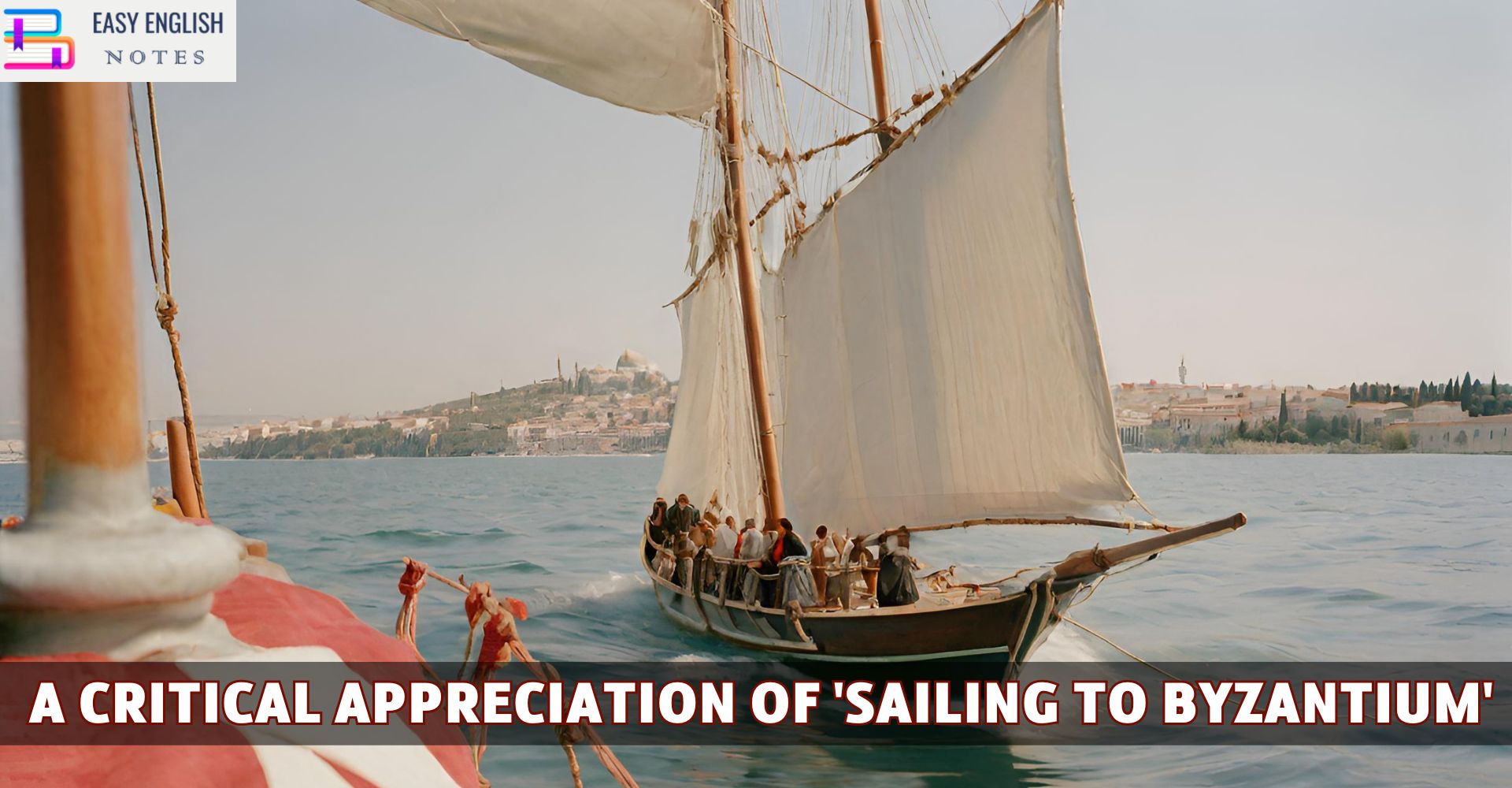
A Critical Appreciation Of ‘Sailing to Byzantium’
“Sailing to Byzantium,” a poem by W.B. Yeats first published in 1928, is one of the most celebrated works in his oeuvre, known for its rich imagery, complex themes, and the exploration of the tension between age and youth, mortality and eternity. The poem reflects Yeats’s deep engagement with history, art, and personal transcendence.
Historically, Byzantium was a city merged into Constantinople. This city was remarkable for its skill of craftsmen and the beauty of buildings.
W.B. Yeats was deeply interested in Byzantium. In his time the poet came into contact with scholars and friends who were acquainted with the history of Byzantium. Besides this, Yeats had a thorough familiarity with the Byzantine art and mosaics through his visit to Italy.
The poet is growing old, and he finds that the country, Ireland, where he is living at present, is not suited to an old man. It is a country in which all lives, all people are given to sensual and sexual pleasures. Birds, beasts, fish and human beings of young age are all indulging in the sensual acts of sex, and therefore, nobody bothers for works of art and literature. Hence, it is safer and better for him to sail to a newer, more spiritual world, for old age is a time of physical decay and decline when man becomes as worthless and helpless as a scarecrow.
In the third stanza, the poet visualizes the great artists in history standing like mosaic figures in holy fire in heaven and, thus undergoing a process of purification. He fervently prays to them to come down from that holy fire, moving rapidly with a circular, spinning motion, and to teach his soul to sing with artistic pleasure. They should purify his heart of all sensual passion, for he can no longer enjoy pleasure of the senses. Purged of all passions, the poet wishes to become a part of the immortal products of art.
Once the soul of the poet is disembodied, he would never again enter the body of any other living creature. He will rather choose to be transformed into such form of art as that of the artificial birds made by the goldsmiths of ancient Greece. He would like to be a golden nightingale as was fashioned by Byzantine artists to sing the past, the present and the future. to keep the king of Byzantium. lords and ladies awake.
Yeats has used the elemental symbols of earth, air, fire and water. The Byzantine image is associated with the image of the golden bough on which the mechanical bird will be set and his inter-linking immensely increases the complexity of meaning. The images are complex. Hammered implies effort, ‘gold’ implies purgation: “gold mosaic’ implies hardness. *holy fire suggests a mode of purification through suffering; and the “get suggests the revolution of historical cycles.
Byzantium has also been treated as a symbol of purgatory where the souls are purified. In the second stanza, the golden bird, as symbol of immortality and art has been used. The Golden Tree with its Golden Bird also reminds us of Yeats association with the Golden Dawn, its magical practices and the Tree of Life. It appears that Yeats has been inspired and motivated to borrow certain images and ideas.
Sailing to Byzantium is a poem in which there is a clash of opposites. The basic idea is the placement of the old against the young. Old age, tells the poet, excludes a man from the sensual joys of youth. The world appears to belong completely to the young, it is no place for the old, indeed, an old man is scarcely a man at all, he is an empty artifice, an effigy merely of a man he is a tattered coat upon a stick.
Also Read :
- Compare Hamlet with Macbeth, Othello and other Tragedies
- “The Pardoner’s Tale” is the finest tale of Chaucer
- Prologue to Canterbury Tales – (Short Ques & Ans)
- Confessional Poetry – Definition & meaning
- Line By Line Explanation Of The Poem The Eve of St. Agnes
Form and Structure:
- The poem consists of four stanzas, each with a regular rhyme scheme. This formal structure reflects the poem’s themes of seeking order and transcendence in the face of aging and chaos.
- Yeats’s use of a consistent meter and a carefully structured rhyme scheme contributes to the poem’s musical quality, a characteristic feature of his later work.
Themes and Ideas:
- Aging and Mortality: The poem opens with a reflection on the physical decline and marginalization associated with old age, set against the backdrop of a youthful and vibrant world. Yeats expresses a longing to escape the limitations of the aging body.
- The Quest for Eternal Art: Yeats contrasts the natural world, associated with the cycle of life and death, with the timeless and unchanging world of Byzantine art. The poem suggests art as a means to achieve immortality, transcending the temporal realm.
- Spiritual and Artistic Journey: “Sailing to Byzantium” can be read as a metaphorical journey – a sailing towards a spiritual and artistic awakening, symbolized by the ancient city of Byzantium, known for its rich history and cultural legacy.
Imagery and Symbolism:
- Yeats employs a wealth of symbols and images in the poem. Byzantium, as a symbol, represents the ideal realm of eternal art and beauty.
- The imagery of birds, both in the natural context of the opening stanza and the artificial golden bird of the final stanza, symbolizes the contrast between mortal, natural life and the immortal, artistic creation.
- The transformation into a mechanical bird made of gold at the end of the poem is a powerful symbol of achieving an immortal artistic form, free from the decay of aging.
Language and Style:
- The language of the poem is rich and lyrical, typical of Yeats’s later style. It combines abstract intellectual concepts with vivid, concrete imagery, creating a tapestry that is both thought-provoking and visually striking.
- The poem’s allusions to history, mythology, and art add depth and layers of meaning, inviting various interpretations and engaging the reader in a dialogue with the past.
Critical Reception:
- “Sailing to Byzantium” is widely regarded as one of Yeats’s most important works. It has been praised for its profound exploration of themes such as the nature of art, the process of aging, and the search for spiritual and artistic fulfillment.
- The poem is often studied for its masterful use of form, its complex thematic construction, and its contribution to modernist poetry.
Conclusion:
“Sailing to Byzantium” stands as a testament to W.B. Yeats’s skill as a poet and his ability to weave together personal, historical, and philosophical themes. The poem’s exploration of the journey towards an artistic and spiritual ideal continues to resonate, making it a timeless piece in the study of modern poetry. It encapsulates Yeats’s enduring preoccupations with aging, art, and the quest for transcendence, marking it as a key work in his poetic legacy.
PLEASE HELP ME TO REACH 1000 SUBSCRIBER ON MY COOKING YT CHANNEL (CLICK HERE)
No Comments