


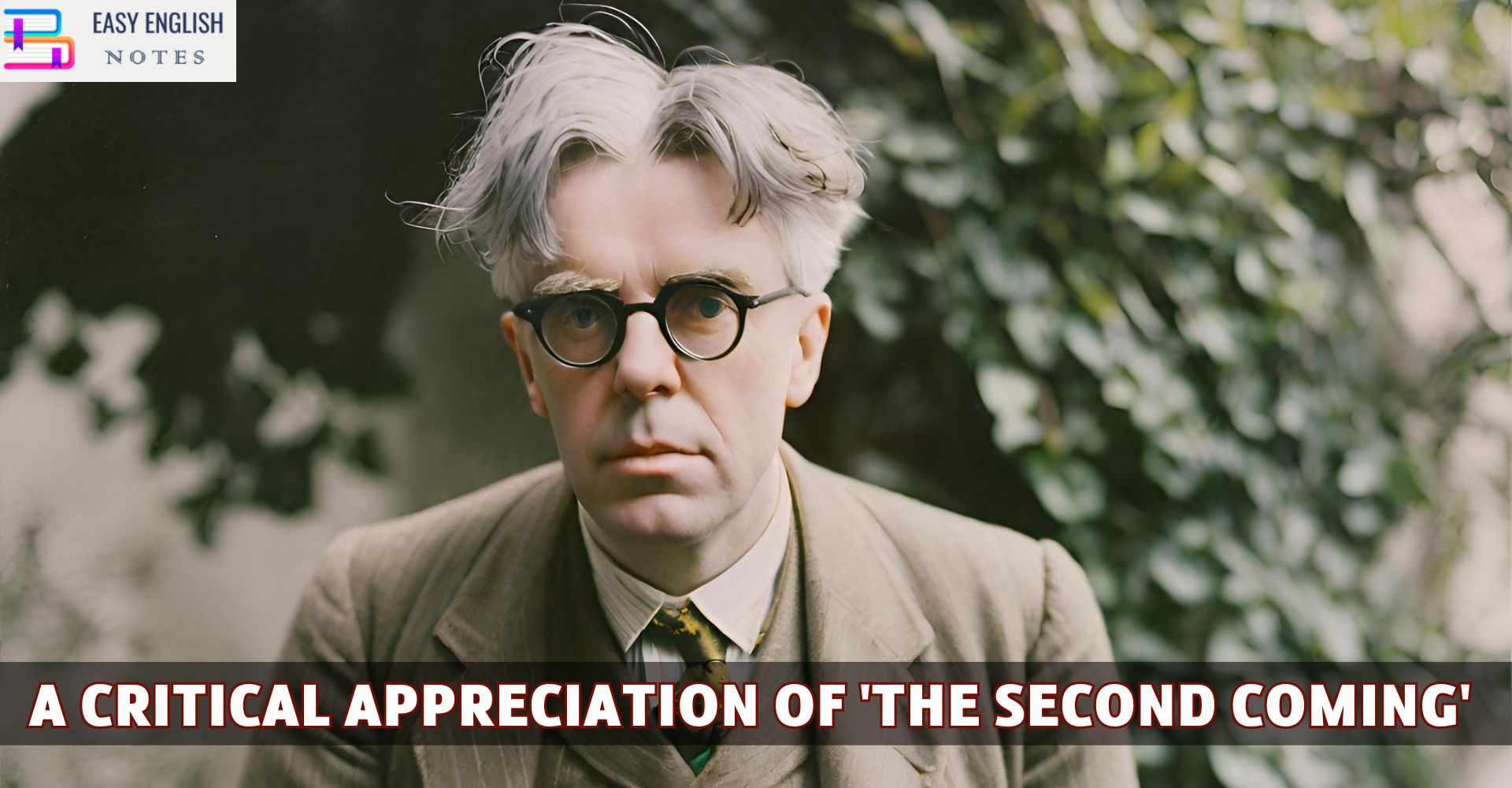
A Critical Appreciation Of ‘The Second Coming’
The Second Coming is one of the finest poems of W.B. Yeats. This is one of the poem most appropriate to our time and place. The lines are stirring, Yeats is certainly inspired by a prophetic vision. In writing his poem, Yeats was able to choose words, which to an appreciable extent were the right ones to reveal or represent the emotion which was its purpose.
The Second Coming is one of the half-dozen or so poem by Yeats which specifically, mention gyres. His restraint in using this technical term is significant and in fact no special knowledge is needed to respond to the sense of circling.
The Second Coming is a mature prophetic poem by William Butler Yeats. In it, Yeats predicts the dawn of an evil age. The Second Coming means the second coming of Jesus Christ. The first stanza introduces the imagery of gyres and the cyclic procession of history in the form of cycles, cones and geometrical images.
The poet believed that the process of history was a cyclic one. He compared it to the movement of rapidly rotating gyres and cones. The gyres spin swiftly round a fixed center. Their circumference widens as they rotate and ultimately disintegration sets in. Yeats believed that the present cycle of history began two thousand years ago; Christ came, and a new civilization was born out of the ruins of the earlier one, such as, the Greeco-Roman civilization which in turn began in 2000 B.C.
The present cycle of the history is almost over and a new history is about to begin. The birth of the new civilization may appear to be the ruin of the old, its values may appear to us monstrous and terrifying, the very thoughts may be a nightmare to us, but this much is sure that a change in the offering.
The sight of the anarchic vision gives the poet a feeling, perhaps, a conviction, that the Second Coming (a new, second avatar) is at hand. As soon as the thought flashes across the poet’s mind, he sees the image of some vast form coming out of Spirtus Mundi, the spirit of the world. It is a kind of storehouse of images in Yeats’ philosophy, which may be the animating force of the world. The poet sees it, and is horrified to see, a sphinxlike being. “a shape with lion’s body and the head of a man, a gaze blank and pitiless as the sun” somewhere in the desert.
This is compared with the activity of the falcon who cannot hear the falconer because of the distance between the two, or because the falcon is at such emotional heat that it refuses to be guided by its master. The result is all-round convulsion in which all finer values of life are lost, anarchy is let loose upon the world. The better people are without a sense of commitment, they have no opinions, they are, as if it were, neutral; while the worst, the undesirable, the rabble, are full of fanatical passions and exhibit their violent tendencies.
Also Read :
- Compare Hamlet with Macbeth, Othello and other Tragedies
- “The Pardoner’s Tale” is the finest tale of Chaucer
- Prologue to Canterbury Tales – (Short Ques & Ans)
- Confessional Poetry – Definition & meaning
- Line By Line Explanation Of The Poem The Eve of St. Agnes
Against the catastrophic forces, the ceremony of innocence is a frail dyke indeed and the very word ‘ceremony helps to suggest the almost formal character of the resistance. The stanza drives to a conclusion which might seem a piece of generalizing, were it not for the rage of imagination behind it. Backed up by the poem, it is decisively, angrily concrete. The wisdom of the best, the center of conviction, the moral basis of order has collapsed; the world lies upon the ‘passionate intensity of those who plunge forward on the blood-dimmed tide.
In the last stanza, there are three key-images; a desert, the flight of birds and a terrific monster moving slowly in the vast stretch of sands. The dominant idea is of ferocity, immensity and vastness, and a feeling of terror is called forth by the emerging pattern in which images apparently dissimilar are linked together by the controlling power of the poet’s vision. The dramatic and dynamic quality of Yeats’ great poem arises out of a complex process of absorption and elimination. He discards all that is redundant and nothing that is significant, seizes on the intense moment of a situation and consequently, evokes from the reader an immediate response to the poetic passion.
In Yeats philosophy Spiritus Mundi’ means a general storehouse of images which have ceased to be the property of any personality or spirit. It is equivalent to Jung’s Collective Unconscious. More directly, in fact, than out of the Spiritus Mundi it is out of the British Museum. which Yeats frequented a great deal when he was in London.
The poet positively asserts that certainly some divination of the essential truth is imminent. Certainly the poet affirms that Jesus Christ will re-incarnate himself for the second time. He will come for the second time to rid the world of evils. “The Second Coming have a magical potency for the poet.
PLEASE HELP ME TO REACH 1000 SUBSCRIBER ON MY COOKING YT CHANNEL (CLICK HERE)
No Comments